Association Between Anemia Severity and Mechanical Ventilation Duration in Patients Admitted to the Intensive Observation Room at Dr. Soetomo General Hospital, Surabaya: A Retrospective Cohort Study
DOI:
https://doi.org/10.55497/majanestcricar.v44i3.529Keywords:
anemia, critical illness, hemoglobin, intensive care units, ventilator weaningAbstract
Introduction: Anemia may impair tissue oxygen delivery in critically ill patients, but its association with weaning and extubation outcomes remains unclear. This study examined the association between anemia severity and mechanical ventilation duration at Dr. Soetomo General Hospital, Surabaya.
Methods: This retrospective cohort study included 107 mechanically ventilated patients admitted from January to June 2022. Anemia severity was classified by hemoglobin levels on ICU admission day 1. Ventilation duration, from initiation to extubation or death, was categorized as <1, 1–3, 4–7, or >7 days. Analyses used Spearman’s rank correlation and the Fisher–Freeman–Halton exact test with Monte Carlo estimation, including trauma-based subgroups. Exploratory survivor analyses included pairwise Mann–Whitney U tests with Holm adjustment.
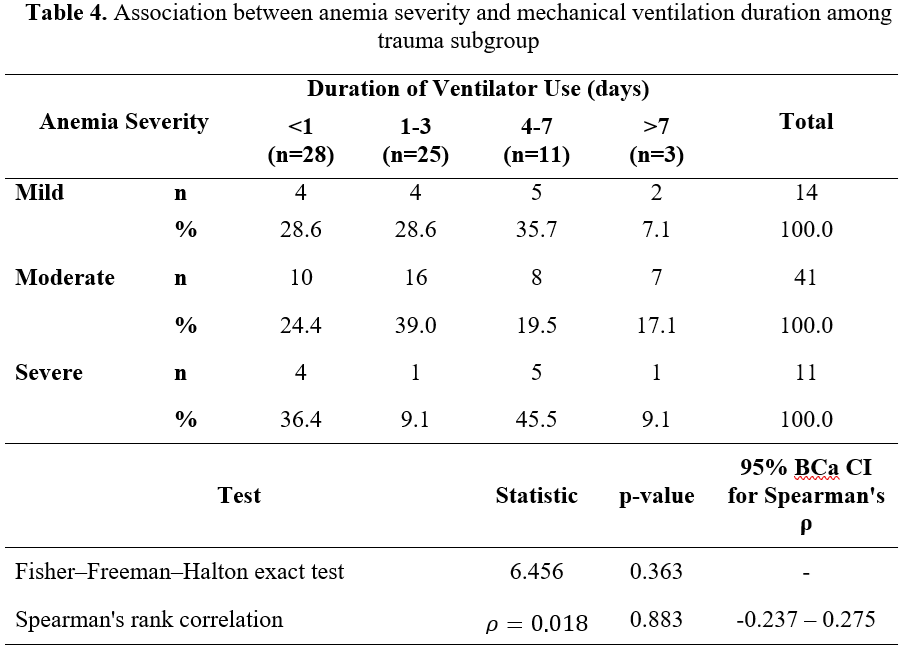
Results: No significant correlation was found in the overall cohort (ρ = 0.121, p = 0.213; 95% BCa CI: −0.093 to 0.309), trauma subgroup (ρ = 0.018, p = 0.883; 95% BCa CI: −0.237 to 0.275), or non-trauma subgroup (ρ = 0.304, p = 0.053; 95% BCa CI: −0.007 to 0.550). Among 67 survivors, a significant positive correlation emerged (ρ = 0.368, p = 0.002; 95% BCa CI: 0.129 to 0.559). Ventilation duration differed significantly between mild and severe anemia (Holm-adjusted p = 0.009) and moderate and severe anemia (p = 0.012), but not mild and moderate anemia (p = 0.104).
Conclusion: No significant correlation was found in the overall cohort or trauma-based subgroups. The positive correlation among survivors should be interpreted cautiously due to potential selection bias. Further studies accounting for confounders are warranted.
Downloads
References
1. Jati SAW, Aditianingsih D, George Y, Risadayanti R. Effect of hemoglobin levels on the success of weaning and extubation processes in critical patients with mechanical ventilation: a systematic review. Bali J Anaesthesiol. 2023;7(4):197-201. doi:10.4103/bjoa.bjoa_263_22.
2. Czempik PF, Krzych ŁJ. Anemia of critical illness: a narrative review. Acta Haematol Pol. 2022. doi:10.5603/ahp.a2022.0016.
3. Elsayed M, Mahmoud SM, Mohamed LH, Omar W, Abdelaziz K. Prediction of outcome in anemic critically ill patients in intensive care unit: a retrospective observational study. Open Access Maced J Med Sci. 2022;10(B):584-8. doi:10.3889/oamjms.2022.7659.
4. Song X, Liu XY, Wang HR, Guo XY, Kashani KB, Ma PL. Association between anemia and ICU outcomes. Chin Med J (Engl). 2021;134(14):1744-6. doi:10.1097/CM9.0000000000001669.
5. Alemayehu M, Azazh A, Hussien H, Baru A. Characteristics and outcomes of mechanically ventilated patients at adult ICU of selected public hospitals in Addis Ababa, Ethiopia. Open Access Emerg Med. 2022;14:395-404. doi:10.2147/OAEM.S369752.
6. Abate SM, Basu B, Jemal B, Ahmed S, Mantefardo B, Taye T. Pattern of disease and determinants of mortality among ICU patients on mechanical ventilator in sub-Saharan Africa: a multilevel analysis. Crit Care. 2023;27(1):37. doi:10.1186/s13054-023-04316-w.
7. Haribhai S, Mahboobi S. Ventilator complications. In: StatPearls [Internet]. Treasure Island (FL): StatPearls Publishing; 2022 [cited 2024 Oct 21]. Available from: https://www.ncbi.nlm.nih.gov/books/NBK560535/
8. Thille AW, Wairy M, Le Pape S, Frat JP. Oxygenation strategies after extubation of critically ill and postoperative patients. J Intensive Med. 2021;1:65-70. doi:10.1016/j.jointm.2021.05.003.
9. World Health Organization. Guideline on haemoglobin cutoffs to define anaemia in individuals and populations. Geneva: World Health Organization; 2024. 57 p.
10. Kementerian Kesehatan Republik Indonesia. Kategori usia [Internet]. Jakarta: Kementerian Kesehatan Republik Indonesia; 2024 [cited 2024 Oct 23]. Available from: https://ayosehat.kemkes.go.id/kategori-usia
11. Centers for Disease Control and Prevention. Body mass index (BMI) [Internet]. Atlanta (GA): Centers for Disease Control and Prevention; 2024 [cited 2026 Jan 23]. Available from: https://www.cdc.gov/bmi/adult-calculator/bmi-categories.html
12. Setiawati Y, Kusumaningtyas MH, d’Arqom A. The response time of trauma and non-trauma patients handling in emergency room Surabaya. Med Health Sci J. 2022;6(1). doi: 10.33086/mhsj.v5i2.2154
13. Sumarlan RD, Setioputro B, Yunanto RA. Factors associated with duration of mechanical ventilation at Intensive Care Unit Dr. Soebandi: a retrospective study. Jurnal Ners. 2022;17(2):168-75. doi:10.20473/jn.v17i2.37864.
14. Fritsch SJ, Dreher M, Simon TP, Marx G, Bickenbach J. Haemoglobin value and red blood cell transfusions in prolonged weaning from mechanical ventilation: a retrospective observational study. BMJ Open Respir Res. 2022;9(1):e001228. doi:10.1136/bmjresp-2022-001228.
15. Li W, Zhang Y, Wang Z, Jia D, Zhang C, Ma X, et al. The risk factors of reintubation in intensive care unit patients on mechanical ventilation: a systematic review and meta-analysis. Intensive Crit Care Nurs. 2023;74:103340. doi:10.1016/j.iccn.2022.103340.
16. Li P, Sun Z, Xu J. Unplanned extubation among critically ill adults: a systematic review and meta-analysis. Intensive Crit Care Nurs. 2022;70:103219. doi:10.1016/j.iccn.2022.103219.
17. Moore EE, Moore HB, Kornblith LZ, Neal MD, Hoffman M, Mutch NJ, et al. Trauma-induced coagulopathy. Nat Rev Dis Primers. 2021;7(1):30. doi:10.1038/s41572-021-00264-3.
18. Littlejohn J, Shen L, Srivastava A, Navare S, Barnhard S. Patient blood management for the critically ill patient. Curr Anesthesiol Rep. 2024;14(3):376-87. doi:10.1007/s40140-024-00637-w.
19. Datta D, Foley R, Wu R, Grady J, Scalise P. Can creatinine height index predict weaning and survival outcomes in patients on prolonged mechanical ventilation after critical illness? J Intensive Care Med. 2018;33(2):104-10. doi:10.1177/0885066616648133.
20. Lasocki S, Pène F, Ait-Oufella H, Aubron C, Ausset S, Buffet P, et al. Management and prevention of anemia (acute bleeding excluded) in adult critical care patients. Ann Intensive Care. 2020;10:111. doi:10.1186/s13613-020-00711-6.
21. Smith EM, Jones JL, Han JE, Alvarez JA, Sloan JH, Konrad RJ, et al. High-dose vitamin D3 administration is associated with increases in hemoglobin concentrations in mechanically ventilated critically ill adults. JPEN J Parenter Enteral Nutr. 2018;42(1):87-94. doi:10.1177/0148607116678197.
Downloads
Published
Issue
Section
License
Copyright (c) 2026 Eillen Theodora, Maulydia Maulydia, Siprianus Ugroseno Yudho Bintoro, Mariza Fitriati, Atika Atika

This work is licensed under a Creative Commons Attribution-NonCommercial 4.0 International License.