Artificial Intelligence for Prediction of Difficult Airway in Anesthesia: A Systematic Review and Descriptive Synthesis
DOI:
https://doi.org/10.55497/majanestcricar.v44i3.527Keywords:
Anesthesia, artificial intelligence, deep learning, difficult airway, machine learningAbstract
Introduction: Difficult airway remains an important cause of anesthesia-related morbidity because failure to identify high-risk airway before induction may lead to repeated laryngoscopy attempts, hypoxemia, aspiration, emergency front-of-neck access, cardiac arrest, or death. This review evaluated artificial intelligence (AI) models for difficult-airway prediction in anesthesia and airway management.
Methods: A systematic literature review with descriptive synthesis was performed using a PICOTS framework and PRISMA-based reporting. PubMed/MEDLINE, Embase, and Scopus were used for the primary evidence map, with supplementary updating through PubMed/MEDLINE, Google Scholar, and reference checking to 13 October 2026. Eligible studies were original human clinical studies using AI, machine learning, deep learning, or computer vision to predict difficult intubation, difficult laryngoscopy, difficult video laryngoscopy, difficult mask ventilation, or composite difficult airway. Studies predicting respiratory-failure intubation or tube size/depth without difficult-airway assessment were excluded.
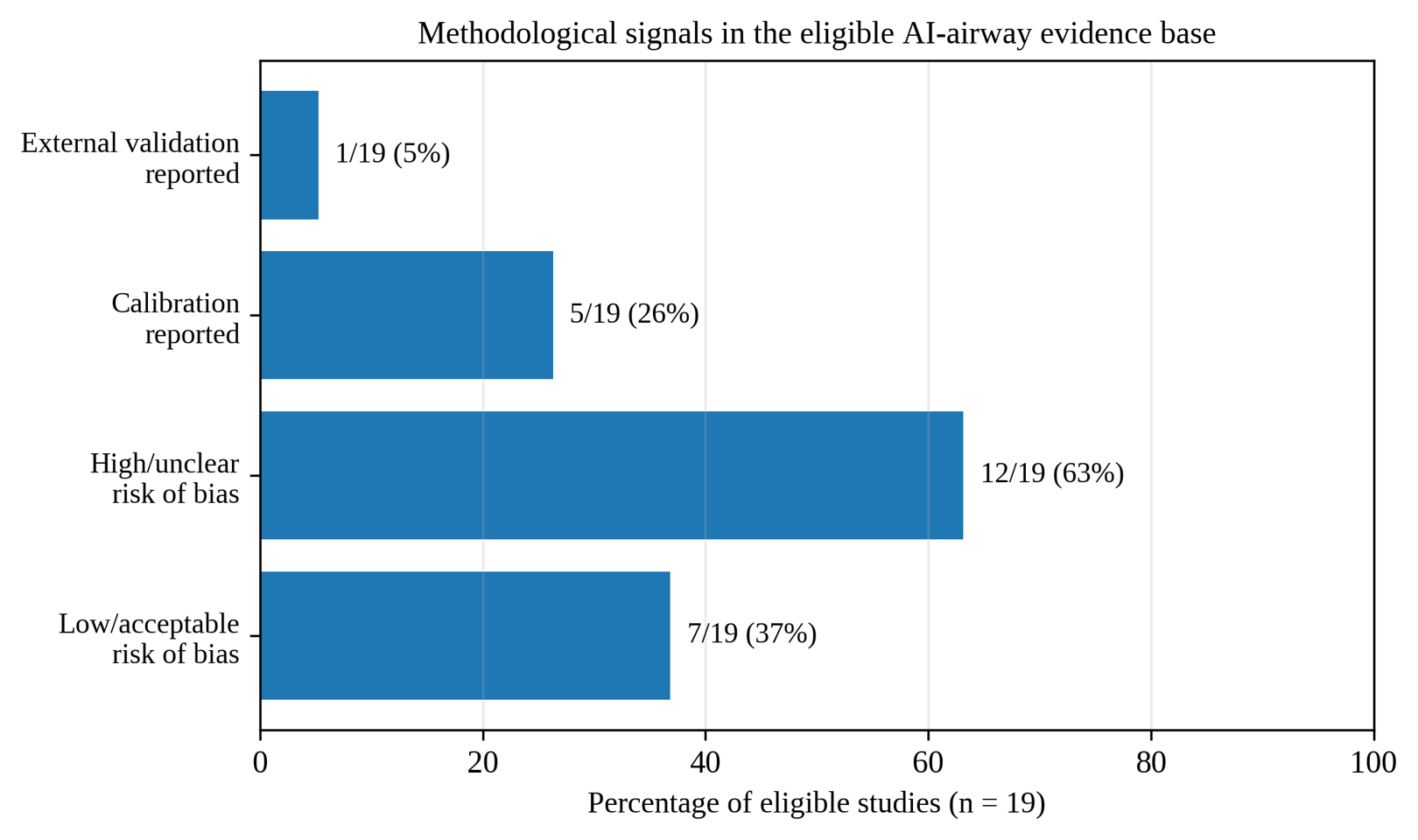
Results: Nineteen eligible difficult-airway-related studies were included in the final descriptive synthesis. Sixteen studies reported extractable AUC or c-statistic values, while three studies were summarized narratively only. One estimate per study was summarized descriptively, with median discrimination of 0.847 (IQR 0.773-0.865; range 0.710-0.970). Calibration was reported in five studies and external validation in one study.
Conclusion: AI models show promising discrimination for difficult-airway prediction, but evidence remains limited by heterogeneous outcome definitions, incomplete calibration reporting, sparse external validation, and uncertain clinical impact. AI should currently be considered an adjunct to anesthesiologist judgment rather than a stand-alone diagnostic method.
Downloads
References
1. Cook TM, Woodall N, Frerk C. Major complications of airway management in the UK: results of the Fourth National Audit Project of the Royal College of Anaesthetists and the Difficult Airway Society. Part 1: anaesthesia. Br J Anaesth. 2011;106(5):617-31. doi:10.1093/bja/aer058
2. Apfelbaum JL, Hagberg CA, Connis RT, Abdelmalak BB, Agarkar M, Dutton RP, et al. 2022 American Society of Anesthesiologists practice guidelines for management of the difficult airway. Anesthesiology. 2022;136(1):31-81. doi:10.1097/ALN.0000000000004002
3. Shiga T, Wajima Z, Inoue T, Sakamoto A. Predicting difficult intubation in apparently normal patients: a meta-analysis of bedside screening test performance. Anesthesiology. 2005;103(2):429-37. doi:10.1097/00000542-200508000-00027
4. Roth D, Pace NL, Lee A, Hovhannisyan K, Warenits AM, Arrich J, et al. Airway physical examination tests for detection of difficult airway management in apparently normal adult patients. Cochrane Database Syst Rev. 2018;5:CD008874. doi: 10.1002/14651858.CD008874.pub2
5. Wang Z, Jin Y, Zheng Y, Chen H, Feng J, Sun J. Evaluation of preoperative difficult airway prediction methods for adult patients without obvious airway abnormalities: a systematic review and meta-analysis. BMC Anesthesiol. 2024;24:242. doi:10.1186/s12871-024-02627-1
6. Norskov AK, Rosenstock CV, Wetterslev J, Astrup G, Afshari A, Lundstrom LH. Diagnostic accuracy of anaesthesiologists' prediction of difficult airway management in daily clinical practice: a cohort study of 188064 patients registered in the Danish Anaesthesia Database. Anaesthesia. 2015;70:272-81. doi:10.1111/anae.12955
7. Shen Y, Wu Y, Qiu Y, Wu J. AI-based decision models for difficult airway assessment: from research innovation to clinical implementation - a narrative review. Front Med (Lausanne). 2026;13:1818061. doi:10.3389/fmed.2026.1818061
8. Collins GS, Moons KGM, Dhiman P, Riley RD, Beam AL, Van Calster B, et al. TRIPOD+AI statement: updated guidance for reporting clinical prediction models that use regression or machine learning methods. BMJ. 2024;385:e078378. doi:10.1136/bmj-2023-078378
9. Moons KGM, Damen JAA, Kaul T, Hooft L, Andaur Navarro C, Dhiman P, et al. PROBAST+AI: an updated quality, risk of bias, and applicability assessment tool for prediction models using regression or artificial intelligence methods. BMJ. 2025;388:e082505. doi:10.1136/bmj-2024-082505
10. Moons KGM, de Groot JAH, Bouwmeester W, Vergouwe Y, Mallett S, Altman DG, et al. Critical appraisal and data extraction for systematic reviews of prediction modelling studies: the CHARMS checklist. PLoS Med. 2014;11(10):e1001744. doi:10.1371/journal.pmed.1001744
11. Page MJ, McKenzie JE, Bossuyt PM, Boutron I, Hoffmann TC, Mulrow CD, et al. The PRISMA 2020 statement: an updated guideline for reporting systematic reviews. BMJ. 2021;372:n71. doi:10.1136/bmj.n71
12. Hayasaka T, Kawano K, Kurihara K, Suzuki H, Nakane M, Kawamae K. Creation of an artificial intelligence model for intubation difficulty classification by deep learning using face images: an observational study. J Intensive Care. 2021;9:38. doi:10.1186/s40560-021-00551-x
13. Tavolara TE, Gurcan MN, Segal S, Niazi MKK. Identification of difficult to intubate patients from frontal face images using an ensemble of deep learning models. Comput Biol Med. 2021;136:104737. doi:10.1016/j.compbiomed.2021.104737
14. Fu C, Luan C, Liu H, Wang W, Zhou X, Jia Y, et al. An ultrasound-based artificial intelligence framework for difficult airway prediction: a two-model, three-step decision framework. PLoS One. 2026;21(2):e0342339. doi:10.1371/journal.pone.0342339
15. Koca E, Kutlusoy S, Er MB, Koca T. Predicting difficult tracheal intubation using multi-angle photographic analysis with convolutional neural networks and EfficientNet. Diagnostics (Basel). 2026;16(7):1042. doi:10.3390/diagnostics16071042
16. Celik F, Aydemir E. Prediction of difficult tracheal intubation by artificial intelligence: a prospective observational study. Duzce Med J. 2021;23(1):47-54. doi:10.18678/dtfd.862467
17. Cho HY, Lee K, Kong HJ, Yang HL, Jung CW, Park HP, et al. Deep-learning model associating lateral cervical radiographic features with Cormack-Lehane grade 3 or 4 glottic view. Anaesthesia. 2023;78:64-72. doi:10.1111/anae.15874
18. Demir Senoglu G, Kara Timucin E, Kirisoglu S. Evaluation of anthropometric and ultrasonographic measurements with different machine learning methods in predicting difficult intubation: a prospective observational study. BMC Anesthesiol. 2025;25:496. doi:10.1186/s12871-025-03370-x
19. Garcia-Garcia F, Lee DJ, Mendoza-Garces FJ, Garcia-Gutierrez S. Reliable prediction of difficult airway for tracheal intubation from patient preoperative photographs by machine learning methods. Comput Methods Programs Biomed. 2024;248:108118. doi:10.1016/j.cmpb.2024.108118
20. Kim JH, Kim H, Jang JS, Hwang SM, Lim SY, Lee JJ, et al. Development and validation of a difficult laryngoscopy prediction model using machine learning of neck circumference and thyromental height. BMC Anesthesiol. 2021;21:125. doi:10.1186/s12871-021-01343-4
21. Kim JH, Choi JW, Kwon YS, Kang SS. Predictive model for difficult laryngoscopy using machine learning: retrospective cohort study. Braz J Anesthesiol. 2022;72:622-8. doi:10.1016/j.bjane.2021.06.016
22. Kim JH, Jung HS, Lee SE, Hou JU, Kwon YS. Improving difficult direct laryngoscopy prediction using deep learning and minimal image analysis: a single-center prospective study. Sci Rep. 2024;14:14209. doi:10.1038/s41598-024-65060-x
23. Kim JH, Han SW, Hwang SM, Lee JJ, Kwon YS. Machine learning predictions and identifying key predictors for safer intubation: a study on video laryngoscopy views. J Pers Med. 2024;14:902. doi:10.3390/jpm14090902
24. Pei B, Jin C, Cao S, Ji N, Xia M, Jiang H. Geometric morphometrics and machine learning from three-dimensional facial scans for difficult mask ventilation prediction. Front Med (Lausanne). 2023;10:1203023. doi:10.3389/fmed.2023.1203023
25. Rodiera C, Fortuny H, Valls A, Borras R, Ramirez C, Ros B, et al. Voice analysis as a method for preoperatively predicting a difficult airway based on machine learning algorithms: original research report. Health Sci Rep. 2024;7:e70246. doi:10.1002/hsr2.70246
26. Xia M, Jin C, Zheng Y, Wang J, Zhao M, Cao S, et al. Deep learning-based facial analysis for predicting difficult videolaryngoscopy: a feasibility study. Anaesthesia. 2024;79:399-409. doi:10.1111/anae.16194
27. Yan S, Guo M, Gao Z, Wu H, Liu X, Yin G, et al. A prediction model for difficult intubation using skeletal features in patients affected by apnea-hypopnea syndrome. Minerva Anestesiol. 2023;89:498-509. doi:10.23736/S0375-9393.22.16869-0
28. Zhou CM, Wang Y, Xue Q, Yang JJ, Zhu Y. Predicting difficult airway intubation in thyroid surgery using multiple machine learning and deep learning algorithms. Front Public Health. 2022;10:937471. doi:10.3389/fpubh.2022.937471
29. Yamanaka S, Goto T, Morikawa K, Watase H, Okamoto H, Hagiwara Y, et al. Machine learning approaches for predicting difficult airway and first-pass success in the emergency department: multicenter prospective observational study. Interact J Med Res. 2022;11(1):e28366. doi:10.2196/28366
30. Sezari P, Kohzadi Z, Dabbagh A, Jafari A, Khoshtinatan S, Mottaghi K, et al. Unravelling intubation challenges: a machine learning approach incorporating multiple predictive parameters. BMC Anesthesiol. 2024;24:453. doi:10.1186/s12871-024-02842-w
Downloads
Published
Issue
Section
License
Copyright (c) 2026 Marcell Dion Wibowo

This work is licensed under a Creative Commons Attribution-NonCommercial 4.0 International License.