Peak Thromboinflammatory Biomarkers and ICU Mortality in Severe Viral Pneumonia
DOI:
https://doi.org/10.55497/majanestcricar.v44i3.515Keywords:
D-dimer, ICU mortality, interleukin-6, severe viral pneumonia, thromboinflammationAbstract
Introduction: Risk stratification in severe viral pneumonia requiring intensive care may benefit from integrating clinical variables and thromboinflammatory biomarkers. This study aim to evaluated the association of peak D-dimer, C-reactive protein (CRP), fibrinogen, and interleukin-6 (IL-6) with ICU mortality.
Methods: This retrospective cohort study used secondary data from confirmed SARS-CoV-2-related severe viral pneumonia patients admitted to the ICU from July to August 2021. Peak biomarker values during ICU care were analyzed with baseline clinical covariates. The primary outcome was ICU mortality. Bivariable testing, logistic regression using log-transformed biomarkers, and receiver operating characteristic analysis were performed.
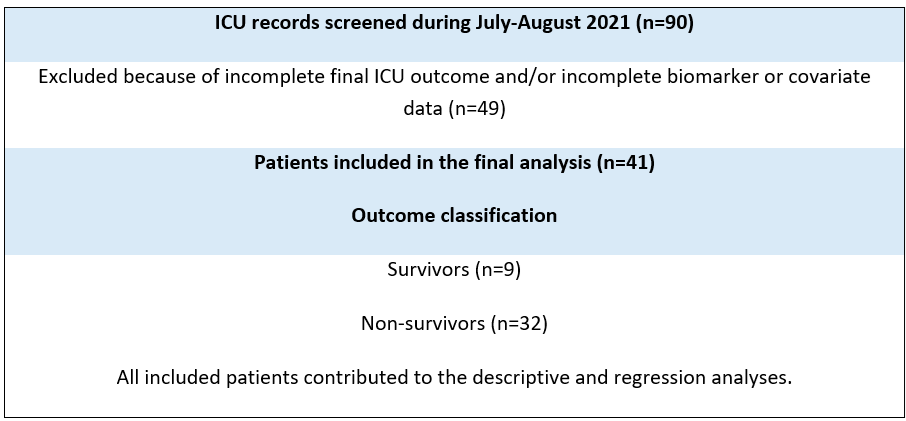
Results: Forty-one patients were included; 32 (78.0%) died. Median D-dimer and CRP were higher among non-survivors, but biomarker differences did not reach statistical significance. Mechanical ventilation was strongly associated with mortality (96.3% vs 42.9%; p<0.001) and remained significant in an adjusted model (OR 60.20; 95% CI 3.52-1029.34; p=0.005). The clinical model yielded an AUC of 0.712, while adding biomarkers increased AUC to 0.788.
Conclusion: In this small ICU cohort, peak thromboinflammatory biomarkers showed directional risk signals but were not statistically significant independent predictors. Requirement for mechanical ventilation was the strongest clinical marker of ICU mortality.
Downloads
References
1. World Health Organization. Clinical management of COVID-19: living guideline. Geneva: World Health Organization; 2025.
2. Ma L, Willey J. The interplay between inflammation and thrombosis in COVID-19: mechanisms, therapeutic strategies, and challenges. Thromb Update. 2022;8:100117. doi:10.1016/j.tru.2022.100117.
3. Putra IMP, Sudiantara PH, Aryawangsa AAN, Panji PAS, Senapathi TGA. Trends in ICU length of stay and in-hospital mortality in Indonesia: A national health insurance claims analysis, 2019-2024. J Crit Care. 2026;94:155523. doi:10.1016/j.jcrc.2026.155523.
4. Milenkovic M, Hadzibegovic A, Kovac M, Jovanovic B, Stanisavljevic J, Djikic M, et al. D-dimer, CRP, PCT, and IL-6 levels at admission to ICU can predict in-hospital mortality in patients with COVID-19 pneumonia. Oxid Med Cell Longev. 2022;2022:8997709. doi:10.1155/2022/8997709.
5. Arturi F, Melegari G, Giansante A, Giuliani E, Bertellini E, Barbieri A. COVID-19 Biomarkers for Critically Ill Patients: A Compendium for the Physician. Neurol Int. 2023 Jul 23;15(3):881-95. doi: 10.3390/neurolint15030056.
6. Popadic V, Klasnja S, Milic N, Rajovic N, Aleksic A, Milenkovic M, et al. Predictors of Mortality in Critically Ill COVID-19 Patients Demanding High Oxygen Flow: A Thin Line between Inflammation, Cytokine Storm, and Coagulopathy. Oxid Med Cell Longev. 2021 Apr 20;2021:6648199. doi: 10.1155/2021/6648199.
7. Eljilany I, Elzouki AN. D-dimer, fibrinogen, and IL-6 in COVID-19 patients with suspected venous thromboembolism: a narrative review. Vasc Health Risk Manag. 2020;16:455-62. doi:10.2147/VHRM.S280962.
8. Hafez W, Nasa P, Khairy A, et al. Interleukin-6 and the determinants of severe COVID-19: A retrospective cohort study. Medicine (Baltimore). 2023;102(45):e36037. doi:10.1097/MD.0000000000036037.
9. Nugroho J, Wardhana A, Maghfirah I, Mulia EPB, Rachmi DA, A'yun MQ, et al. Relationship of D-dimer with severity and mortality in SARS-CoV-2 patients: a meta-analysis. Int J Lab Hematol. 2021;43(1):110-5. doi:10.1111/ijlh.13336.
10. Collins GS, Reitsma JB, Altman DG, Moons KGM. Transparent Reporting of a Multivariable Prediction Model for Individual Prognosis or Diagnosis (TRIPOD): the TRIPOD statement. Ann Intern Med. 2015;162(1):55-63. doi:10.7326/M14-0697.
11. Moons KGM, Altman DG, Reitsma JB, Ioannidis JPA, Macaskill P, Steyerberg EW, et al. Transparent Reporting of a multivariable prediction model for Individual Prognosis or Diagnosis (TRIPOD): explanation and elaboration. Ann Intern Med. 2015;162(1):W1-W73. doi:10.7326/M14-0698.
12. Wynants L, Van Calster B, Collins GS, Riley RD, Heinze G, Schuit E, et al. Prediction models for diagnosis and prognosis of COVID-19: systematic review and critical appraisal. BMJ. 2020;369:m1328. doi:10.1136/bmj.m1328.
13. Connors JM, Levy JH. COVID-19 and its implications for thrombosis and anticoagulation. Blood. 2020;135(23):2033-40. doi:10.1182/blood.2020006000.
14. COVID-ICU Group on behalf of the REVA Network and the COVID-ICU Investigators. Clinical characteristics and day-90 outcomes of 4244 critically ill adults with COVID-19: a prospective cohort study. Intensive Care Med. 2021;47(1):60-73. doi:10.1007/s00134-020-06294-x.
15. Grasselli G, Greco M, Zanella A, Albano G, Antonelli M, Bellani G, et al. Risk factors associated with mortality among patients with COVID-19 in intensive care units in Lombardy, Italy. JAMA Intern Med. 2020;180(10):1345-55. doi:10.1001/jamainternmed.2020.3539.
16. Van Calster B, McLernon DJ, van Smeden M, Wynants L, Steyerberg EW. Calibration: the Achilles heel of predictive analytics. BMC Med. 2019;17(1):230. doi:10.1186/s12916-019-1466-7.
17. Riley RD, Ensor J, Snell KIE, Harrell FE Jr, Martin GP, Reitsma JB, et al. Calculating the sample size required for developing a clinical prediction model. BMJ. 2020;368:m441. doi:10.1136/bmj.m441.
18. Tang N, Li D, Wang X, Sun Z. Abnormal coagulation parameters are associated with poor prognosis in patients with novel coronavirus pneumonia. J Thromb Haemost. 2020;18(4):844-847. doi:10.1111/jth.14768
Downloads
Published
Issue
Section
License
Copyright (c) 2026 I Made Prema Putra, Made Wirga Wirgunatha, Putu Ugi Sugandha, I Made Harry Pranata, Putu Eka Nantha Kusuma, I Gusti Ngurah Mahaalit Aribawa, I Gusti Agung Gede Utara Hartawan, Putu Agus Surya Panji, Made Wiryana

This work is licensed under a Creative Commons Attribution-NonCommercial 4.0 International License.